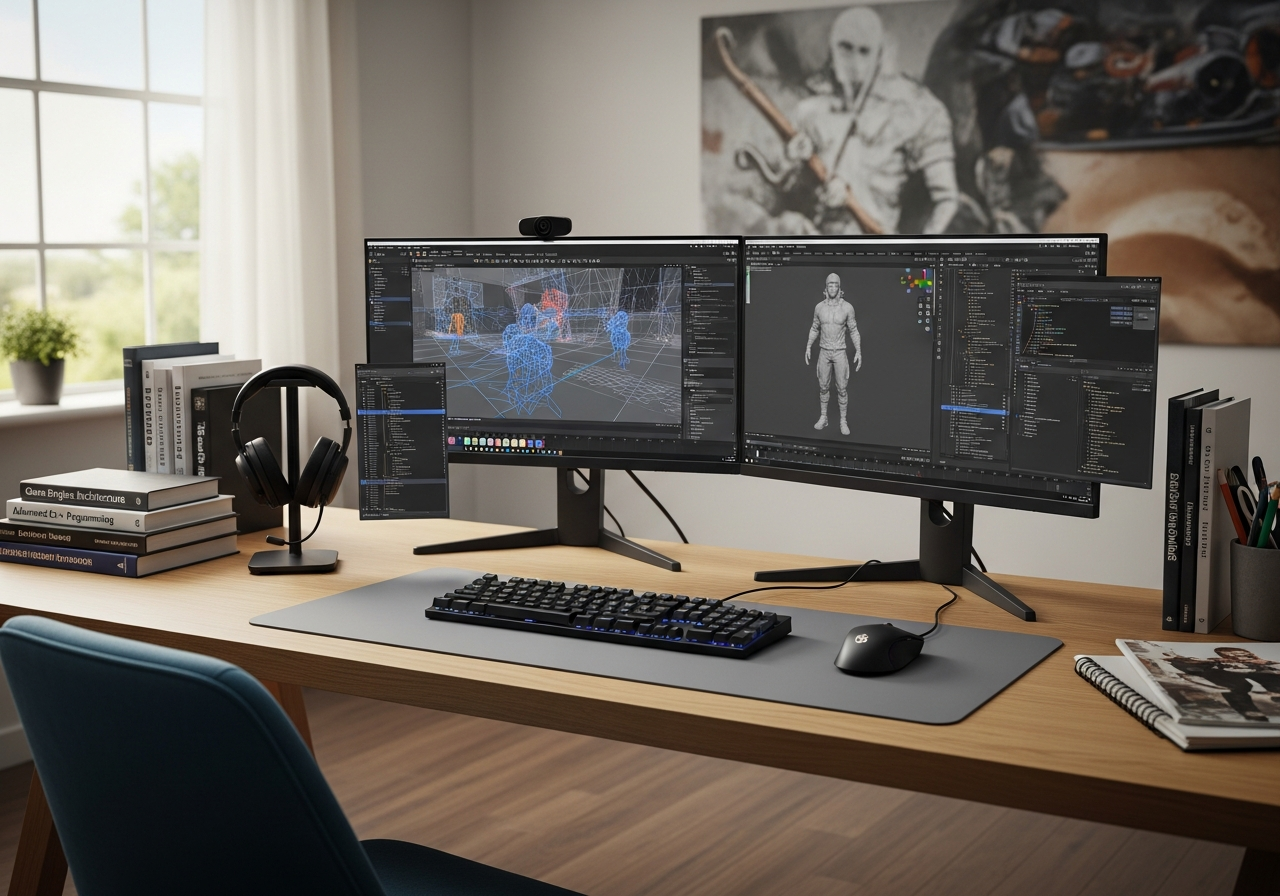
Choosing the right Canadian game development program means understanding how Unity and Unreal Engine are woven into your curriculum. Canadian schools take distinct approaches to engine training—some prioritize Unity’s accessibility for rapid prototyping, others dive deep into Unreal’s AAA-quality visuals, and many blend both strategically across different terms.
The engine focus you choose shapes everything from your daily coding language to your final portfolio projects. Canadian curricula don’t just teach button-clicking; they integrate Unity’s C# scripting and cross-platform deployment alongside Unreal’s Blueprint visual scripting and cinematic tools, creating learning paths that mirror real studio workflows and prepare you for specific career trajectories in Canada’s growing game industry.
How Canadian Game Engine Curricula Are Structured
Canadian game development education follows three main tracks: intensive 1-year diplomas that rapidly cycle through both engines, comprehensive 2-4 year degree programs that layer engine complexity across multiple terms, and focused bootcamps targeting specific engine proficiencies. Most programs adopt a blended model where Unity introduces core concepts early, followed by Unreal’s advanced pipeline tools.
These programs emphasize project-based learning with 15-25 contact hours weekly, integrating engine training directly into design, art, and programming courses rather than treating them as isolated technical skills. Students work in studio-like teams, moving from individual Unity prototypes to collaborative Unreal showcases that mirror professional development cycles.
The curriculum structure varies significantly between institutions, with some front-loading engine exposure and others spreading it across the entire program duration. Canadian schools particularly excel at connecting engine training to portfolio development, ensuring each project builds toward industry-ready demonstration reels.
| Program Type | Typical Duration | Engine Exposure Pattern | Common Canadian Examples |
|---|---|---|---|
| Diploma | 1-2 years | Unity first 2 terms, Unreal final terms | Vancouver Film School, NAIT |
| Bachelor’s Degree | 3-4 years | Parallel Unity/Unreal with specialization tracks | University of Ontario, UQAC |
| Bootcamp | 3-6 months | Single engine focus with rapid iteration | Lighthouse Labs, RED Academy |
| Certificate | 6-12 months | Engine-agnostic fundamentals with electives | BCIT, Seneca College |
| Graduate Diploma | 1-2 years | Advanced specialization in chosen engine | Sheridan College, Humber |
Typical Engine Learning Path by Term in Canada
Most Canadian programs begin with Unity fundamentals in term one, introducing C# scripting basics, 2D game mechanics, and simple 3D scene construction. Term two typically advances to Unity’s animation systems, UI design, and mobile deployment, while simultaneously introducing Unreal Engine’s interface and Blueprint visual scripting concepts.
By term three, students dive deeper into Unreal’s rendering pipeline, advanced lighting systems, and C++ integration, often working on team projects that combine both engines strategically. Final terms focus on capstone projects where students choose their primary engine based on career goals, creating portfolio-worthy games that demonstrate mastery of their chosen toolset.
Intensive 1-year programs compress this timeline dramatically, covering Unity basics in the first 3 months, Unreal fundamentals in months 4-6, and culminating in dual-engine projects that showcase versatility. These accelerated paths require significant self-study but produce graduates comfortable switching between engines based on project requirements.
Integrated vs Standalone Engine Courses
Canadian schools typically integrate engine training across multiple course streams rather than teaching engines in isolation. Programming courses use Unity for C# fundamentals while art courses leverage Unreal for advanced shader work and cinematic sequences. This integrated approach mirrors professional workflows where engine choice depends on project needs rather than arbitrary preferences.
However, some programs offer standalone “Engine Fundamentals” modules that compare Unity and Unreal directly, teaching transferable concepts like scene management, asset pipelines, and performance optimization. These courses excel at building engine-agnostic thinking, preparing students to adapt quickly as new tools emerge in the rapidly evolving game development landscape.
Competitive Canadian schools emphasize team projects with studio-like workflows, where programmers might prototype in Unity while artists create final assets in Unreal, requiring seamless collaboration and asset pipeline management. This approach develops crucial communication skills alongside technical engine proficiency.
Unity vs Unreal: Core Differences That Shape Curriculum Design
The fundamental differences between Unity and Unreal Engine directly influence how Canadian curricula are structured and sequenced. Unity’s C# scripting and component-based architecture make it ideal for introductory programming courses, while Unreal’s Blueprint visual scripting and advanced rendering capabilities suit later-term projects focusing on AAA-quality visuals and complex systems integration.
Canadian programs typically leverage Unity’s cross-platform strength for mobile and XR projects early in the curriculum, building student confidence with successful deployments to multiple platforms. Unreal enters the curriculum later when students have solid programming foundations, allowing them to appreciate its advanced tools for lighting, physics, and cinematic storytelling without being overwhelmed by complexity.
The learning curve differences significantly impact student experience, with Unity providing faster initial wins and portfolio pieces, while Unreal demands more technical depth but produces more visually impressive results. Canadian educators balance these factors carefully, ensuring students don’t plateau on Unity’s easier entry point while providing adequate support for Unreal’s steeper learning requirements.
| Dimension | Unity Focus in Curriculum | Unreal Focus in Curriculum | Impact on Canadian Student Experience |
|---|---|---|---|
| Programming Language | C# scripting with gentle learning curve | C++ and Blueprint hybrid approach | Unity builds confidence early; Unreal teaches industry standards |
| Visual Fidelity | Good graphics with manual optimization | AAA-quality rendering out of the box | Unity teaches fundamentals; Unreal impresses employers |
| Platform Deployment | Seamless cross-platform builds | PC/console focused with mobile limitations | Unity enables diverse portfolios; Unreal targets specific markets |
| Learning Resources | Abundant beginner tutorials and documentation | Advanced documentation with steeper entry | Unity supports self-directed learning; Unreal requires guided instruction |
| Asset Store Ecosystem | Massive marketplace for rapid prototyping | Curated marketplace with high-quality assets | Unity teaches asset integration; Unreal emphasizes custom creation |
| Industry Usage | Indie, mobile, and XR development focus | AAA games and film/architecture visualization | Unity opens diverse career paths; Unreal targets premium studios |
| Team Collaboration | Version control requires setup and training | Built-in collaborative tools and source control | Unity teaches external tool integration; Unreal streamlines workflows |
| Performance Optimization | Manual profiling and optimization required | Advanced profiling tools built-in | Unity develops optimization skills; Unreal provides powerful analysis |
Programming Approaches: C#, C++ and Blueprint Visual Scripting
Unity’s C# scripting provides Canadian students with a gentle introduction to object-oriented programming concepts, using familiar syntax that transfers well to other languages and frameworks. The component-based architecture teaches modular thinking, where students learn to break complex game systems into reusable, testable pieces that can be mixed and matched across different projects.
Unreal Engine presents a dual-track programming approach that caters to different learning styles and career paths within Canadian programs. Blueprint visual scripting allows artists and designers to create complex interactions without traditional coding, while C++ integration provides the performance and flexibility demanded by AAA development, creating a balanced skillset that appeals to diverse industry roles.
Canadian curricula often use Unity’s C# foundation to teach programming fundamentals, then transition to Unreal’s Blueprint system to demonstrate visual programming concepts, finally advancing to C++ for students pursuing technical programming specializations. This progression builds confidence while maintaining rigorous technical standards.
Inside a Unity-First Canadian Curriculum
Unity-first Canadian programs prioritize rapid prototyping and iterative design, beginning with 2D game development to establish core programming concepts before advancing to 3D environments. Students start with simple mechanics like movement and collision detection, gradually building complexity through physics systems, particle effects, and user interface design that translates across multiple platforms.
These curricula emphasize Unity’s strength in cross-platform deployment, with students publishing games to mobile devices, web browsers, and VR headsets within their first few months. This approach builds confidence through tangible results while teaching crucial skills like resolution scaling, input management, and performance optimization across different hardware constraints.
Advanced Unity curriculum modules cover asset store integration, custom shader development, and multiplayer networking, preparing students for indie development roles where versatility and rapid iteration matter more than cutting-edge visuals. The focus remains on creating multiple completed projects rather than perfecting single showcase pieces.
- Master C# fundamentals through Unity’s scripting API, building solid programming foundation with immediate visual feedback
- Develop 2D game prototypes covering core mechanics, UI systems, and mobile-optimized performance techniques
- Create 3D environments with physics, lighting, and animation systems while learning asset pipeline management
- Build cross-platform projects for mobile, web, and XR platforms, understanding deployment and optimization challenges
- Design multiplayer games using Unity’s networking tools, covering client-server architecture and real-time synchronization
- Integrate third-party assets and plugins, learning to evaluate and implement external solutions efficiently
- Complete capstone project demonstrating full development cycle from concept to published build
Typical Unity Skills You Graduate With in Canada
Canadian Unity-focused graduates develop comprehensive C# scripting abilities, moving beyond basic syntax to advanced concepts like delegates, coroutines, and scriptable objects that enable scalable game architecture. They master Unity’s component system, creating reusable scripts that handle everything from player movement to complex AI behaviors using state machines and behavior trees.
Portfolio projects showcase proficiency in Unity’s integrated tools including animation systems, particle effects, and audio management, with graduates comfortable creating polished user experiences across multiple platforms. They understand performance optimization techniques specific to mobile and web deployment, crucial skills for Canada’s growing indie game sector.
- Advanced C# scripting with Unity API mastery for gameplay systems, UI management, and performance optimization
- Cross-platform deployment expertise covering mobile, web, desktop, and XR with platform-specific optimization techniques
- Animation and timeline system proficiency for character movement, cutscenes, and interactive storytelling elements
- Asset pipeline management including texture compression, model optimization, and efficient resource loading strategies
- Multiplayer networking implementation using Unity’s built-in tools for real-time and turn-based game modes
- Custom shader development and visual effects creation for unique art styles and performance-optimized rendering
- Version control and team collaboration workflows using Git and Unity’s collaborative features for professional development
Who a Unity-Focused Program Best Suits
Unity-focused Canadian programs excel for students targeting indie game development, mobile gaming, or XR/VR creation where rapid prototyping and cross-platform deployment provide competitive advantages. These programs suit creative individuals who prefer accessible coding paths that don’t sacrifice technical depth, allowing artists and designers to implement their own ideas without extensive programming backgrounds.
Students aiming for entrepreneurial paths in Canada’s indie scene benefit most from Unity’s versatility, enabling them to create diverse portfolio pieces across multiple genres and platforms. The engine’s lower learning curve allows more time to focus on game design fundamentals, business development, and marketing skills essential for independent developers navigating Canada’s competitive gaming landscape.
Inside an Unreal-Heavy Canadian Curriculum
Unreal-heavy Canadian programs immerse students in AAA development workflows from day one, emphasizing visual fidelity, advanced lighting systems, and cinematic storytelling techniques that mirror professional game studios and film production pipelines. Students work with Unreal’s advanced rendering features like Lumen global illumination, Nanite virtualized geometry, and MetaHuman character creation tools that produce industry-standard results.
These curricula balance Blueprint visual scripting for rapid iteration with C++ programming for performance-critical systems, teaching students to make strategic technical decisions based on project requirements. Advanced modules cover Unreal’s integrated tools for motion capture, procedural content generation, and real-time ray tracing that position graduates for roles in high-end game development and emerging media applications.
Canadian Unreal programs emphasize team-based development using industry-standard source control and asset management workflows, preparing students for collaborative environments where technical artists, programmers, and designers must coordinate effectively. Projects often span multiple terms, allowing deep exploration of Unreal’s sophisticated pipeline tools and optimization techniques.
- Blueprint visual scripting mastery enabling complex gameplay systems without traditional programming barriers
- Advanced C++ integration for performance optimization and custom engine modifications tailored to project needs
- Cinematics and storytelling using Sequencer tool for cutscenes, trailers, and interactive narrative experiences
- Advanced lighting and rendering techniques including real-time ray tracing, volumetric fog, and dynamic global illumination
- Physics simulation and destruction systems for realistic environmental interactions and special effects
- Procedural content generation using Unreal’s built-in tools for landscape creation and architectural visualization
- Performance profiling and optimization strategies for maintaining smooth gameplay across different hardware configurations
Unreal Features Commonly Taught in Canadian Programs
Canadian Unreal curricula systematically introduce students to the engine’s most powerful features through project-based learning that builds complexity over time. Beginning with Blueprint fundamentals, students progress through advanced systems like material editor, landscape tools, and animation blueprints, culminating in sophisticated projects that demonstrate mastery of Unreal’s integrated workflow.
Each feature connects to portfolio development strategy, with instructors guiding students to create demonstration reels that showcase specific technical competencies valued by Canadian game studios, film production companies, and architectural visualization firms. The emphasis remains on creating polished, professional-quality work that stands out in competitive job markets.
| Feature/System | How It Is Used in Class Projects | Portfolio Value |
|---|---|---|
| Blueprint Visual Scripting | Create interactive mechanics and UI systems without traditional coding | Demonstrates technical problem-solving for design-focused roles |
| Lumen Global Illumination | Build realistic lighting scenarios for environmental storytelling | Essential for AAA, film, and architectural visualization work |
| Sequencer Cinematic Tool | Create cutscenes, trailers, and narrative sequences with professional timing | Valuable for narrative design and technical artist positions |
| MetaHuman Character System | Develop photorealistic characters with advanced facial animation | High-demand skill for film, games, and virtual production |
| Niagara Particle Systems | Design complex visual effects for combat, magic, and environmental ambience | Showcases technical artistry and system optimization skills |
| Chaos Physics System | Implement realistic destruction and physics-based puzzles | Demonstrates understanding of performance vs visual fidelity trade-offs |
| World Partition System | Build massive open-world environments with streaming optimization | Critical for open-world and AAA development roles |
Canadian Programs that Blend Unity and Unreal
Leading Canadian institutions like Vancouver Film School have pioneered dual-engine curricula that strategically leverage each platform’s strengths throughout the program duration. These blended approaches typically introduce Unity for foundational concepts and rapid prototyping, then transition to Unreal for advanced visualization and team projects, creating graduates comfortable with both ecosystems and able to choose appropriate tools based on project requirements.
The blended model offers significant advantages in technical versatility and job market adaptability, as Canadian graduates can pursue opportunities across indie studios favoring Unity and AAA developers standardized on Unreal. However, this approach risks shallower specialization compared to single-engine programs, requiring careful curriculum design to ensure adequate depth in both platforms while maintaining reasonable program duration.
Canadian schools implementing dual-engine training report higher graduate employment rates and starting salaries, as students demonstrate broader technical competency and adaptability valued by employers facing diverse project requirements. The key success factor lies in strategic sequencing that builds transferable concepts while providing adequate hands-on time in each engine to develop genuine proficiency.
| Curriculum Model | Unity Usage | Unreal Usage | Pros for Students |
|---|---|---|---|
| Sequential (VFS Style) | Terms 1-2 for programming fundamentals and prototyping | Terms 3-4 for advanced visuals and team projects | Solid foundation before complexity; clear progression path |
| Parallel Specialization | Ongoing for mobile/indie track students | Ongoing for AAA/visualization track students | Deep specialization with cross-training exposure |
| Project-Based Switching | Mobile and XR projects throughout program | AAA and cinematic projects throughout program | Practical tool selection skills; diverse portfolio |
| Integrated Workflow | Prototyping and asset testing phases | Final production and polishing phases | Real industry workflow simulation; efficient development |
Term-by-Term Example: From Unity Prototype to Unreal Showcase
A typical Canadian dual-engine program begins with Unity prototyping in term one, where students create simple 2D games focusing on core mechanics, player feedback, and rapid iteration cycles. Term two expands into 3D Unity projects with basic physics and animation, establishing solid programming fundamentals and project management skills before introducing additional complexity.
Term three marks the transition to Unreal Engine, where students rebuild their Unity prototypes using Blueprint visual scripting and advanced rendering systems, directly comparing workflow differences and technical capabilities. This parallel development approach reinforces learning while demonstrating each engine’s strengths for specific project types and target platforms.
Final terms focus on original capstone projects where students choose their primary engine based on career goals and project vision, while maintaining competency in both platforms through peer collaboration and cross-engine asset sharing. This progression creates graduates who understand when and why to select specific tools rather than blindly following personal preferences.
How Dual-Engine Training Affects Portfolio Strategy
Students in dual-engine Canadian programs must carefully curate their portfolios to demonstrate competency without appearing scattered or unfocused to potential employers. The most successful graduates highlight transferable skills like game design thinking, optimization techniques, and collaborative development while showcasing specific technical achievements in each engine that align with their target career paths.
Portfolio strategy typically involves creating one major project in each engine, plus several smaller pieces that demonstrate versatility and adaptability. Students learn to present their dual-engine experience as a strategic advantage, emphasizing their ability to choose appropriate tools and collaborate effectively across different technical ecosystems common in Canadian game development.
- Create signature projects in both engines showcasing unique strengths rather than duplicating similar gameplay mechanics
- Emphasize transferable skills like optimization, asset pipeline management, and collaborative development workflows
- Document technical decision-making process showing when and why specific engines were chosen for projects
- Include collaborative works demonstrating ability to integrate assets and coordinate across different engine ecosystems
- Highlight specialization depth in chosen primary engine while maintaining demonstrated competency in secondary platform
Skill Outcomes: What You Really Learn Beyond Just Engines
Canadian game development curricula use Unity and Unreal as vehicles for teaching fundamental programming concepts, design thinking, and collaborative workflows that transcend any specific technology platform. Students develop systematic problem-solving approaches, learning to break complex interactive systems into manageable components regardless of the underlying engine architecture or scripting language.
The real value lies in understanding game development pipelines, asset optimization techniques, and user experience design principles that apply across all interactive media creation. Canadian programs emphasize team collaboration, version control, and project management skills through studio simulation exercises where students rotate through different roles and responsibilities while working toward common project goals.
Beyond technical proficiency, graduates develop critical thinking skills for evaluating new tools, frameworks, and emerging technologies as the game development landscape continues evolving. They learn to communicate technical concepts to non-technical team members, document their work effectively, and adapt quickly to changing project requirements and industry standards.
Canadian curricula also stress ethical considerations in game design, including accessibility, representation, and responsible monetization strategies that prepare students for leadership roles in Canada’s socially conscious game development community. These broader outcomes ensure graduates contribute positively to the industry while building successful technical careers.
From Engine Tools to Production Mindset
Canadian programs systematically transition students from tool-focused learning to production-oriented thinking, where technical decisions align with project goals, timeline constraints, and team capabilities. This evolution typically spans multiple terms, beginning with individual technical exercises and progressing toward collaborative projects that simulate real studio environments and delivery pressures.
The progression develops crucial project ownership skills, teaching students to balance technical perfectionism with practical delivery requirements while maintaining quality standards appropriate for their target audience and platform constraints. Students learn to prioritize features, optimize assets, and debug systematically under realistic time pressure that mirrors professional game development cycles.
- Master individual tool proficiency through guided tutorials and structured assignments with clear technical benchmarks
- Apply tools creatively to original projects while learning to evaluate technical trade-offs and performance implications
- Collaborate effectively in small teams, managing version control, asset sharing, and integration challenges
- Take ownership of specific game systems within larger projects, coordinating with team members and meeting deadlines
- Debug complex integration issues and optimize performance across different hardware and platform constraints
- Polish final builds to professional standards including user testing, feedback integration, and deployment processes
Choosing Your Unity vs Unreal Focus in Canada
Career goals should drive your engine focus decision, with Unity offering stronger paths toward indie development, mobile gaming, and XR/VR creation that align with Canada’s diverse game industry ecosystem. Students targeting entrepreneurial ventures benefit from Unity’s lower licensing costs, cross-platform deployment capabilities, and extensive asset store ecosystem that enables rapid prototyping and market testing of original game concepts.
Unreal Engine better serves students aiming for AAA studios, film industry integration, and architectural visualization roles concentrated in major Canadian cities like Vancouver, Toronto, and Montreal. The engine’s advanced rendering capabilities and industry-standard workflows provide direct entry points to established studios while building technical skills valued across entertainment and emerging media sectors.
Consider your learning style preferences when choosing engine focus, as Unity’s gentle learning curve suits self-directed learners who prefer iterative improvement, while Unreal’s steeper initial complexity rewards students who thrive on technical challenges and systematic deep-dive learning approaches. Both paths lead to successful careers when aligned with individual strengths and market opportunities.
Canadian job market demand supports both engine specializations, with Unity roles often emphasizing creativity and rapid iteration skills while Unreal positions typically require deeper technical knowledge and collaborative development experience. Regional variations exist, with western Canadian cities showing stronger AAA Unreal demand while eastern markets offer more Unity-based mobile and indie opportunities.
- Align engine choice with target career path: Unity for indie/mobile/XR roles, Unreal for AAA/film/visualization positions
- Consider regional job market strengths across different Canadian cities and their dominant industry focuses
- Evaluate your learning style preferences: Unity rewards iterative creativity, Unreal demands systematic technical depth
- Factor in long-term industry trends like XR growth (Unity advantage) versus AAA visual standards (Unreal strength)
- Assess portfolio building timelines: Unity enables faster initial projects, Unreal produces more impressive visual results
- Research specific Canadian studios in your target locations to understand their technology preferences and hiring patterns
Matching Engine Focus to Canadian Job Titles
Canadian game industry job titles correlate strongly with engine preferences, though flexibility between platforms increasingly becomes a valuable differentiator for candidates in competitive markets. Understanding these connections helps students make strategic curriculum choices that align with their career aspirations and the specific technical requirements of their target roles within Canada’s diverse gaming ecosystem.
Entry-level positions often accept broader engine experience, while senior roles typically demand deep specialization in specific platforms that match studio technical infrastructure and project requirements. Canadian employers particularly value candidates who understand when and why to choose specific engines rather than those with rigid platform preferences that may not fit project needs.
| Target Role (Canada) | Preferred Engine Focus | Recommended Curriculum Traits | Portfolio Pieces to Showcase |
|---|---|---|---|
| Indie Game Developer | Unity primary with Unreal exposure | Cross-platform deployment, rapid prototyping, business development | Published mobile games, innovative mechanics, complete game loops |
| AAA Gameplay Programmer | Unreal primary with C++ emphasis | Team collaboration, performance optimization, system architecture | Complex gameplay systems, optimized code samples, team project leadership |
| XR/VR Developer | Unity specialization with XR SDKs | Spatial design, performance optimization, user comfort | VR experiences, hand tracking demos, optimization case studies |
| Technical Artist | Dual-engine competency preferred | Shader development, pipeline tools, artist-programmer bridge | Custom shaders, automation tools, visual effects systems |
| Mobile Game Developer | Unity focus with platform optimization | Performance optimization, monetization, analytics integration | Released mobile titles, performance benchmarks, user retention data |
| Game Designer | Unity for prototyping, engine-agnostic thinking | Rapid prototyping, user testing, design documentation | Innovative prototypes, design documents, user testing results |
| Visualization Specialist | Unreal with architectural/film focus | Photorealistic rendering, real-time ray tracing, cinematic tools | Architectural walkthroughs, cinematic sequences, lighting studies |
Questions to Ask Canadian Schools About Engine Training
Prospective students should investigate curriculum depth and practical application opportunities beyond surface-level engine exposure, focusing on hands-on project time, industry mentorship availability, and post-graduation career support specific to their chosen engine specialization. Understanding term-by-term progression helps evaluate whether programs provide adequate depth or merely survey different technologies without building genuine competency.
Portfolio development support varies significantly between Canadian institutions, with the strongest programs providing individual guidance, industry feedback opportunities, and showcase events that connect students with potential employers. Ask about alumni employment outcomes specific to engine specializations and regional job placement success rates to gauge program effectiveness for your career goals.
- How many hours of hands-on engine development time does each term provide beyond lectures and demonstrations?
- Which terms introduce each engine, and what specific competencies should students achieve by program completion?
- Do students work on individual projects, team collaborations, or both throughout their engine training sequence?
- What portfolio development support and industry feedback opportunities are available for engine-specific projects?
- How do faculty stay current with rapidly evolving engine features and industry workflow changes?
- What relationships exist with local studios for internships, guest lectures, and potential employment opportunities?
- Can students access both engines after graduation for continued learning and portfolio development projects?
Maximizing ROI From a Canadian Unity/Unreal Program
Success in Canadian game engine programs requires active engagement beyond minimum assignment requirements, with top-performing students consistently creating additional projects, participating in game development communities, and seeking mentorship from industry professionals and experienced faculty members. Building relationships early in your program pays dividends through collaborative opportunities, career guidance, and potential job referrals upon graduation.
Canadian programs offer unique advantages through proximity to major game development hubs and active local development communities that provide networking, feedback, and career opportunities unavailable in other regions. Students should actively participate in local meetups, game jams, and industry events to build professional networks while developing practical skills that complement their formal education.
Portfolio development requires strategic planning throughout your program rather than frantic final-term efforts, with successful graduates building comprehensive project collections that demonstrate technical growth, creative problem-solving, and collaborative abilities valued by Canadian employers. Document your learning process, technical challenges overcome, and team contributions to create compelling narratives around your projects during job interviews.
Consider entrepreneurial opportunities within Canada’s supportive indie game ecosystem, where government funding programs, tax incentives, and business development resources enable student projects to evolve into commercial ventures with proper planning and execution during and after formal education completion.
Practical Tips to Stand Out in Both Engines
Exceptional students go beyond curriculum requirements by exploring advanced engine features, contributing to open-source projects, and creating tutorial content that demonstrates deep technical understanding while building professional reputation within Canadian development communities. These activities differentiate graduates in competitive job markets while developing communication and leadership skills valued in senior development roles.
Game jam participation provides intensive learning opportunities and networking connections unavailable through classroom settings alone, with Canadian events like TOJam and Global Game Jam offering platforms to test skills under pressure while collaborating with diverse teams and potential future colleagues or business partners.
- Create polished, fully-playable builds with professional UI, sound design, and optimization rather than impressive technical demonstrations lacking gameplay depth
- Participate actively in Canadian game jams and development competitions to build networking connections and test skills under realistic time constraints
- Contribute to online communities by sharing tutorials, code samples, or development insights that demonstrate expertise while building professional visibility
- Seek advanced certifications or specializations in specific engine areas like XR development, multiplayer networking, or technical art workflows
- Collaborate with students from complementary programs (art, design, business) to create interdisciplinary projects that showcase teamwork and communication abilities
- Document development processes thoroughly to create compelling portfolio narratives about problem-solving approaches and technical decision-making skills